
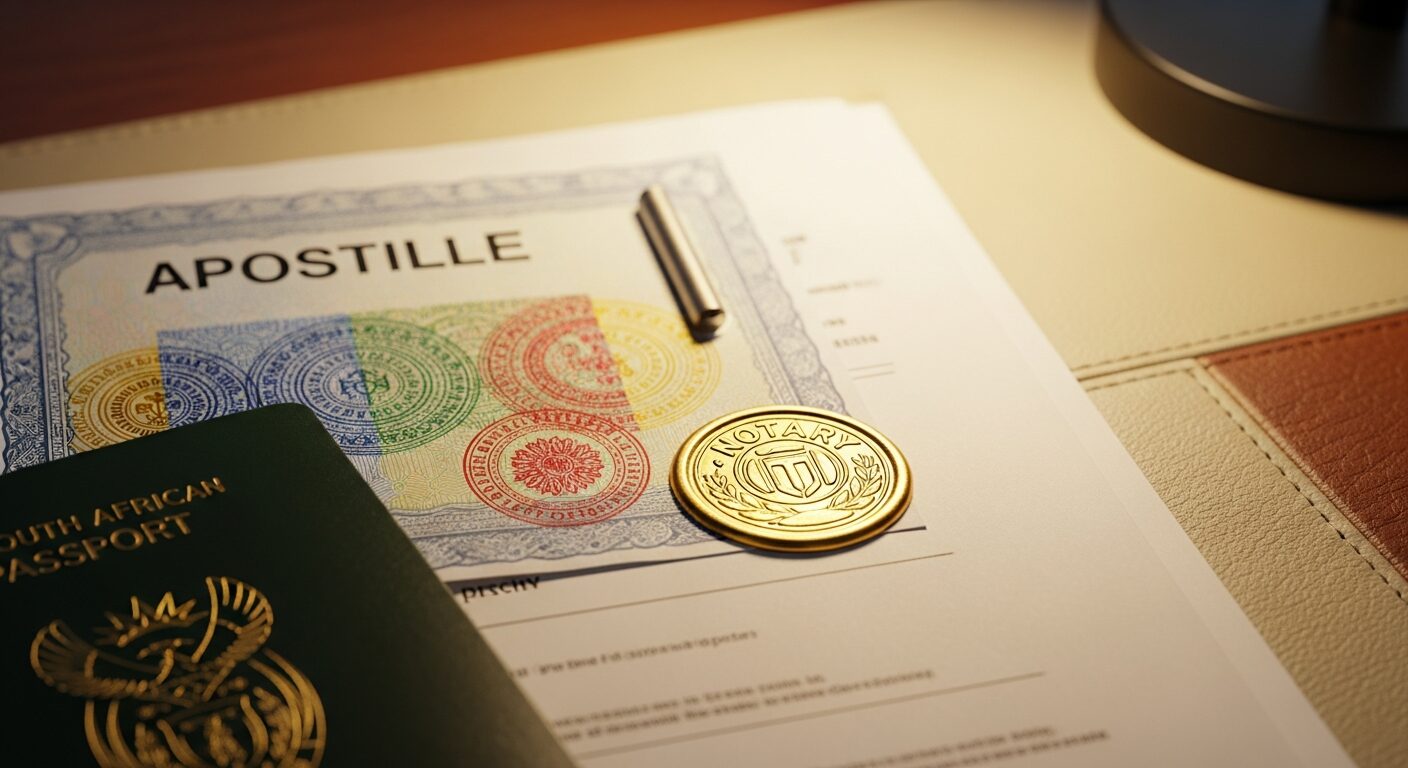
When a South African document needs to be used outside the country, the ordinary process of certification or commissioning is usually not enough. Foreign institutions, government departments, employers, universities and courts in other countries have their own requirements for accepting documents from South Africa, and those requirements often involve steps that go beyond a certified copy or a signature in front of a commissioner of oaths.
The two most common requirements are a notarial copy and an apostille. These are different steps, used in different situations, and they are often confused. Understanding what each one does, when it is required, and how the process works in South Africa makes it possible to prepare properly rather than discovering halfway through a visa application or a property transaction abroad that the documents are insufficient.
What a notarial copy is and when it is used
A notarial copy is a copy of a document that has been certified by a notary public. The notary examines the original document, compares it with the copy, and issues a certificate confirming that the copy is a true and accurate reproduction of the original. That certificate is executed under the notary's seal and signature and carries a legal status that an ordinary certified copy does not.
Notarial copies are required in a range of situations. Foreign immigration authorities, financial institutions, property registries and courts in certain countries will not accept ordinary certified copies of documents such as identity documents, marriage certificates, divorce orders, academic qualifications, company documents or wills. They require notarial copies because the notary's involvement provides a higher and more verifiable level of authentication.
The notary's role in preparing a notarial copy is not mechanical. The notary must be satisfied that the original document is genuine, that the copy accurately reflects it, and that the certificate correctly identifies the document and the nature of the notarial act performed. Where the notary has doubts about the original, or where the original is itself a copy of another document, the notary will need to address that carefully.
The apostille and the Hague Convention
An apostille is a specific certificate that authenticates the signature and official capacity of the person who signed a public document, so that the document is accepted in other member countries of the Hague Convention Abolishing the Requirement of Legalisation for Foreign Public Documents. South Africa acceded to the Hague Apostille Convention, and most countries with which South Africans commonly need to deal are also members.
The apostille does not verify the content of the underlying document. It verifies the origin and authority of the document, confirming that the person who signed it did so in an official capacity recognised under South African law. Once an apostille has been attached, the document is in principle accepted in all other Hague Convention member states without any further authentication.
Examples of documents that commonly go through the apostille process include birth certificates, death certificates, marriage certificates, divorce orders, police clearance certificates, educational transcripts and certificates, court orders, and company documents. In each case, the document must have been issued or executed by a recognised public authority, or in the case of a private document, must have been notarised first so that the notary's signature itself becomes the subject of the apostille.
How the apostille process works in South Africa
The issuing of apostilles in South Africa is handled by designated Competent Authorities. For many public documents, the relevant authority is DIRCO, the Department of International Relations and Co-operation. In certain cases, including some court documents, the High Court acts as the Competent Authority. Educational certificates from recognised institutions may be authenticated through the relevant provincial education authority or SAQA depending on the circumstances.
The practical process typically involves submitting the original or certified document to the relevant Competent Authority with an application and the prescribed fee. The apostille certificate is then attached to the document. Processing times vary and can be affected by the workload of the authority and whether the application is submitted in person or by post.
Where a private document such as a power of attorney, a declaration, a notarial copy or a company document needs an apostille, the standard route is for the notary to execute the document first. The notary's signature and seal are then verified through DIRCO, which issues the apostille on the notarial act. This is why the notary's involvement and proper execution of the underlying document matter so much. An incorrectly prepared or executed document may be rejected at the apostille stage, causing delay and additional cost.
Legalisation for non-Hague countries
Not all countries are members of the Hague Apostille Convention. For documents going to a country that has not acceded to the Convention, a different and more involved process applies. That process is known as legalisation and involves a chain of authentication rather than a single apostille.
Legalisation typically requires the document to be authenticated by DIRCO and then further authenticated by the embassy or consulate of the receiving country in South Africa. Some countries also require that the document be translated into their official language by an accredited translator and that the translation itself be authenticated. Requirements vary significantly between countries and can change, which is why those requirements should be confirmed in advance rather than assumed.
Common preparation mistakes
Many clients present documents for notarisation or authentication that turn out to be unsuitable for the intended purpose. Laminated documents cannot be notarised in the normal way because the lamination prevents physical examination of the security features. Documents that are torn, faded, stapled in a way that obscures information, or that bear unexplained marks or endorsements may cause difficulty. Documents in a language other than the official language of the receiving country may require translation alongside authentication.
Another common issue is using a certified copy of an already-certified copy. An apostille or notarial act carried out on a second-generation copy may be questioned. In some matters, the original document must be obtained or the chain of copies must be clearly established.
Timing and planning
One of the most consistent practical challenges is timing. Visa applications, property transactions, immigration procedures, and academic enrolments all have deadlines, and the apostille and authentication process can take longer than people expect. DIRCO processing, embassy requirements, and the need to obtain replacement documents where originals are not available all contribute to the timeline.
Dealing with notarial copies and apostilles early and in consultation with the notary avoids the considerable stress of trying to solve a documentation problem days before a deadline. A notary who understands what the foreign institution or authority requires, and who prepares the documents correctly the first time, is the most reliable way to navigate a process that is less straightforward than it appears.
The correct approach begins with understanding exactly what the receiving country or institution requires, obtaining the original documents, working with a notary who prepares the notarial acts properly, and then following the apostille or legalisation process in the right sequence. Getting any step wrong can mean starting again, which is exactly what careful preparation is designed to prevent.